Portfolio Category: EDUCATIONAL

  • Heyser Audio Relational Glossary – Perception and Access

    Heyser Audio Relational Glossary – Perception and Access

    This is prototype knowledge compass for navigating complex audio concepts through relational structure. It rethinks how technical knowledge is structured, accessed, and understood. Interpretive layering and directional relationships between perception and technical understanding allow movement between concepts. It stands as a companion glossary to Richard C Heyser’s works on Time Delay Spectrometry, and an aid to tuning in to felt alignment between systems of perception.

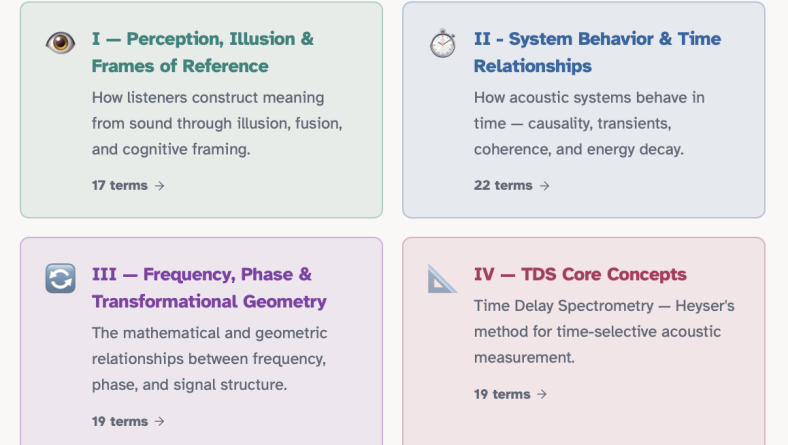
    The audio measurement concepts are laid out in six interconnected modules:

    I — Perception, Illusion & Frames of Reference

    II — System Behavior & Time Relationships

    III — Frequency, Phase & Transformational Geometry

    IV — TDS Core Concepts

    V — Energy, Space & Room Interaction

    VI — Measurement Philosophy & Interpretation


    Try the Heyser Audio Relational Glossary by following this link to Vercel:

    https://knowledge-compass-weld.vercel.app


    Phase II of this module looks at the peer review process of interpretive works.

    This project started out as a way of navigating Heyser’s work to create accessible mini-lessons. I thought I’d donate the work to the nonprofit Audio Engineering Society. However, between the IT challenges the society has faced and the need for modern peer-reviewed audio terminology once they get through those challenges, I decided to use my work interpreting Heyser to test the collaborative layer of GitHub. After returning to the relational module for several breakthrough teachable moments, I decided to further incorporate it into a larger project.

  • Pain Is Not What It Seems by Anita Hickey MD

    Pain Is Not What It Seems by Anita Hickey MD

    Pain Is Not What It Seems

    Pain Is Not What It Seems by Anita Hickey MD, Morgan James Publishing, In Production

    [soundcloud url=”https://api.soundcloud.com/tracks/559611468″]

    With a better understanding of healing, we can change the paradigm of treating and preventing chronic pain and disease.

    While conventional Western medicine tends to treat the body and mind as separate entities, scientific evidence proves that physical, spiritual, and psychological aspects of self affect one another on a profound level. This book explains the science that tells us that only when these deeper spiritual and emotional issues are addressed can true healing from suffering and pain begin.

      • Learn why simply treating symptoms is an ineffective way to address pain and illnesses, even if at first glance the problem appears to be strictly physical.
      • Reaffirm what you realize intrinsically, that you are a whole person with physical, spiritual, and psychological aspects which all affect one another
      • Learn how and why guilt, shame, and other long-repressed feelings can continue to plague a person long after the immediately apparent emotional distresses have subsided, over time creating imbalances such as anxiety, depression, insomnia, and high blood pressure – or in more serious ways, such as chronic intractable pain or other severe illnesses.

    After thirty years treating military and civilian patients with chronic and acute pain and associated disorders, Dr. Anita Hunt Hickey shares profound wisdom and insights of the “secrets” behind how to heal from intractable complex pain, which although published in scientific journals and books are not taught to most doctors nor found in standard wellness curriculums. Her astonishingly simple and transformative program provides an easy-to-follow path to healing from suffering and pain.

    Dr. Anita Hunt Hickey trained in Pain Medicine at Harvard’s Beth Israel Deaconess Medical Center and Boston Children’s Hospital. She is a speaker with 30+ years’ experience treating military and civilian patients with chronic and acute pain with a focus on the use of Integrative and Holistic Pain Medicine. Her work includes participating in numerous working groups on pain management and integrative medicine for the Department of Defense and the VA and she was selected as US Navy Integrative Medicine and Pain Medicine representative for the Army Surgeon General’s task force on pain management. Dr. Hickey lives and works in Chula Vista, CA.

  • Understanding Susan Sontag by Carl Rollyson

    Understanding Susan Sontag by Carl Rollyson

    Understanding Susan Sontag by Carl Rollyson, The University of South Carolina Press, Nonfiction, American History, Audiobook Release Date: April 10, 2017


    A comprehensive account of the author’s entire career through the lens of her recently published diaries.

    With the publication of Susan Sontag’s diaries, the development of her career can now be evaluated in a more genetic sense so that the origins of her ideas and plans for publication are made plain in the context of her role as a public intellectual who was increasingly aware of her impact on her culture. In Understanding Susan Sontag, Carl Rollyson not only provides an introduction to her essays, novels, plays, films, diaries, and uncollected work published in various periodicals; he now has a lens through which to reevaluate classic texts such as Against Interpretation and On Photography, providing both students and advanced scholars a renewed sense of her importance and impact.

    Rollyson devotes separate chapters to Sontag’s biography; her early novels; her landmark essay collections Against Interpretation and Styles of Radical Will; her films; her major mid-career books, On Photography and its sequel, Regarding the Pain of Others; and Illness as Metaphor and its sequel, AIDS and Its Metaphors, together with her groundbreaking short story, “The Way We Live Now.” Sontag’s later essay collections and biographical profiles, collected in Under the Sign of Saturn, Where the Stress Falls, and At the Same Time: Essays and Speeches, also receive a fresh assessment, as does her later work in short fiction, the novel, and drama, with a chapter discussing I, etcetera; two historical novels, The Volcano Lover and In America; and her plays, A Parsifal, Alice in Bed, and her adaptation of Ibsen’s The Lady from the Sea. Chapters on her diaries and uncollected prose, along with a primary and secondary bibliography, complete this comprehensive study.

    Carl Rollyson, professor of journalism at Baruch College, the City University of New York, is the author of A Real American Character: The Life of Walter Brennan, A Private Life of Michael Foot, Amy Lowell Anew: A Biography, American Isis: The Life and Art of Sylvia Plath, Hollywood Enigma: Dana Andrews, Marilyn Monroe: A Life of the Actress, Lillian Hellman: Her Life and Legend, Beautiful Exile: The Life of Martha Gellhorn, Norman Mailer: The Last Romantic, and three studies of biography.

    Review:

    “In Understanding Susan Sontag, Carl Rollyson lucidly and critically engages Sontag’s career as a writer, filmmaker, tastemaker, and theater director. This book will introduce Sontag to students at the same time that it brings new knowledge to more advanced readers. Of particular value to the specialist are the chapter on Sontag’s posthumously published journals and an appendix that surveys Sontag’s uncollected work. Rollyson’s book makes an outstanding contribution to the Understanding Contemporary American Literature series by appealing to an audience of students, serious readers, and academics.”―Barbara Ching, Iowa State University

    About The Author:

    Carl Rollyson, Professor of Journalism at Baruch College, The City University of New York, has published more than forty books ranging in subject matter from biographies of Marilyn Monroe, Lillian Hellman, Martha Gellhorn, Norman Mailer, Rebecca West, Susan Sontag, and Jill Craigie to studies of American culture, genealogy, children’s biography, film, and literary criticism. He has authored more than 500 articles on American and European literature and history. His work has been reviewed in newspapers such as The New York Times and the London Sunday Telegraph and in journals such as American Literature and the Dictionary of Literary Biography. For four years (2003-2007) he wrote a weekly column, “On Biography,” for The New York Sun and was President of the Rebecca West Society (2003-2007). His play, THAT WOMAN: REBECCA WEST REMEMBERS, has been produced at Theatresource in New York City. Amy Lowell Anew: A Biography (awarded a “We the People” NEH grant) will be published in August 2013. . “Hollywood Enigma: Dana Andrews, a biography of Dana Andrews was published in September 2012 by University Press of Mississippi. His biography, “American Isis: The Life and Death of Sylvia Plath” was published in February 2013, the fiftieth anniversary of her death. In 2013, he also published Amy Lowell Anew: A Biography, and in 2014 Marilyn Monroe Day by Day. His biography/memoir A Private Life of Michael Foot will be published in August 2015. He is currently at work on two books, Memoirs of a Serial Biographer and a biography of William Faulkner. His reviews of biography appear regularly in The Wall Street Journal, The Minneapolis Star Tribune, The Raleigh News & Observer, The Kansas City Star, and The New Criterion. He is currently advisory editor for the Hollywood Legends series published by the University Press of Mississippi. He welcomes queries from those interested in contributing to the series. Read his column, “Biographology,” and his blog on http://carlrollyson.com.
  • Reiki Meditation by Faye Bridges

    Reiki Meditation by Faye Bridges

    Reiki Meditation by Faye Bridges

    Reiki Meditations

    Reiki is a very spiritual healing method and like many spiritual methods there are a lot of misconceptions about the practice. It probably doesn’t help that Reiki itself is shrouded in mystery. The author of this book provides insight into some of the common myths that surround the practice of Reiki to help clear up some of the mystery surrounding this spiritual approach. Even though Reiki is spiritual in nature don’t let that scare you off. It is simply an alternative medicinal approach to healing the body.

    In the first chapter of this book you are going to discover what Reiki is, as well as how it can help you. The author keeps the basics short and sweet. Then the author discusses the five basic principles of Reiki which form together to create The Reiki Creed, which is the foundation that all Reiki practitioners follow.

    In the course of the second chapter the author goes on to discusses the importance of Reiki attunements. Attunements are a necessary part of Reiki as they help to prepare the body for treatments. Knowing what to expect and how to prepare your body for an attunement takes a lot of the guesswork out of Reiki and ensures a successful treatment.

    In this book you will learn the basics of a Reiki treatment, how each of the five symbols are used, as well as the hand placements used by Reiki practitioners on their recipients.

    Reiki as a holistic healing method can be practiced on others, but practitioners can also use this practice to heal themselves.

    Reiki treatments are often delivered via a single practitioner, but in rare cases recipients take part in something called a Reiki Circle. You will learn all about Reiki Circles and when they are useful for recipients….


  • Virtual Afterlives: Grieving the Dead in the Twenty-First Century

    Virtual Afterlives: Grieving the Dead in the Twenty-First Century

    [soundcloud url=”https://api.soundcloud.com/tracks/280592394″] Virtual Afterlives: Grieving the Dead in the Twenty-First Century by Candi K. Cann, Sociology & Death, University of Kentucky Press, Redwood Audiobooks, Narrated by Lesley Ann Fogle, Release Date: September 13, 2016

    For millennia, the rituals of death and remembrance have been fixed by time and location, but in the twenty-first century, grieving has become a virtual phenomenon. Today, the dead live on through social media profiles, memorial websites, and saved voicemails that can be accessed at any time. This dramatic cultural shift has made the physical presence of death secondary to the psychological experience of mourning.

    Virtual Afterlives investigates emerging popular bereavement traditions. Author Candi K. Cann examines new forms of grieving and evaluates how religion and the funeral industry have both contributed to mourning rituals despite their limited ability to remedy grief. As grieving traditions and locations shift, people are discovering new ways to memorialize their loved ones. Bodiless and spontaneous memorials like those at the sites of the shootings in Aurora and Newtown and the Boston Marathon bombing, as well as roadside memorials, car decals, and tattoos are contributing to a new bereavement language that crosses national boundaries and culture-specific perceptions of death.

    Examining mourning practices in the United States in comparison to the broader background of practices in Asia and Latin America, Virtual Afterlives seeks to resituate death as a part of life and mourning as a unifying process that helps to create identities and narratives for communities. As technology changes the ways in which we experience death, this engaging study explores the culture of bereavement and the ways in which it, too, is being significantly transformed.

    The author examines four primary categories of popular memorialization, in an order that reflects the gradually disappearing body: (1) Bodiless memorials (2) Tattoo memorials, (3) Car-decal and T-shirt memorials, and (4) Internet and social network memorials.
    Virtual Afterlives__________________________________________________________________

    Candi K. Cann received her Ph.D. from Harvard University in the Study of Religion and is interested in the way in which the dead are remembered and memorialized by the living. She studies religious memorialization (martyrs) and popular forms of contemporary memorialization such as tattoo memorials and car decal memorials. She is an avid reader, traveler, and lover of poetry, but her passions are spending time with her family, friends and living well.
    __________________________________________________________________

    “With sensitivity and insight, Cann deftly charts a change in American mourning practices related to changing Western views of death as a privatized, bodiless experience. She brilliantly explains the rise of roadside memorials, car decals, and body tattoos as recent manifestations of first, a public seeking to mourn in a society that emphasizes life and hides death, and second, the removal of the body from the experience of death.”

    ―Simon Bronner, Distinguished University Professor of American Studies and Folklore and director of the American Studies doctoral program at Pennsylvania State University, Harrisburg

    “Cann argues that the way we grieve and memorialize the dead has shifted in recent years. She carefully takes the reader on a journey that reveals the metamorphosis of memorialization and ways of grieving that are more private today, yet at the same time are brought out into the public sphere in creative ways via cyberspace, tattoos, t-shirts, bodiless memorials, and automobile decals.”

    ―George Dickinson, professor of sociology at the College of Charleston and author of Understanding Dying, Death and Bereavement

  • Savory Suppers and Fashionable Feasts: Dining in Victorian American

    Savory Suppers and Fashionable Feasts: Dining in Victorian American

    Savory Suppers Victorian Dining
    Savory Suppers and Fashionable Feasts: Dining in Victorian American by Susan Williams, Nonfiction History, Redwood Audiobooks, Narrated by Lesley Ann Fogle, Release Date: July 2016

    Savory Suppers and Fashionable Feasts offers a delightfully flavorful tour of dining in America during the second half of the 19th century.

    Historian Susan Williams investigates the manners and morals of that era by looking at its eating customs and cooking methods. As she reveals, genteel dining became an increasingly important means of achieving social stability during a period when Americans were facing significant changes on a variety of fronts – social, cultural, intellectual, technological, and demographic.

    Focusing on the rapidly expanding middle class, Williams not only examines mealtime rituals, but she looks at the material culture of Victorian dining: the furniture, the furnishings, and the growing array of accouterments – from asparagus tongs to sardine servers and lace doilies – that supported genteel expectations for tableside behavior. She also explores changing ideas about meals – how they fit into the daily schedule and what kinds of food and drink came to characterize specific meals and menus. The result is at once an informative look at life in Victorian America, and a sumptuous celebration of a key moment in the country’s culinary experience.

    “This lively and informative volume gives a good general picture of the eating patterns of the middle and upper classes in late 19th-century America. With its many choice quotations and entertaining anecdotes, this well-written book should appeal to a wide audience. Highly recommended.” (Library Journal)

  • “Secrets of Rome” for IMAX

    “Secrets of Rome” for IMAX

    “Secrets of Rome” for IMAX, produced by White Gate Films, narrated by Lesley Ann Fogle

    I read an American and British version for this trailer.

  • Sound Pressure Waves

    Sound Pressure Waves

    [soundcloud url=”https://api.soundcloud.com/tracks/207138270″]